
Who are you if your career disappears?
We can spend years working on our careers without pausing to consider how those careers interact with the rest of our lives. Somewhere along the way, who we are can become tangled up with what we do. When that happens, a promotion, a raise, or a good performance review can become the thing we reach for to feel better about ourselves. Criticism of our work can feel like criticism of who we are. There is very little space between the person and the profession.
Here’s a little thought exercise for you. Setting money aside: imagine your bills would still be paid if you lost your job tomorrow. How would you feel?
Now imagine your entire profession disappeared, and you could never do that work again. Would you feel lost? Incomplete? Would it feel as though everything you had done was wasted?
Those feelings can really tell us a lot about how closely fused our identity might be with our work. We notice this when something about our work gets criticized or rejected and we take it as a mark on who we are. And… when we’re trying to find relief from that, we look for it in our career. We chase a promotion, a higher bonus, a pay raise, or a new job all together. We feel that if we can just have our work validated it will mean we’re a whole person that has worth.
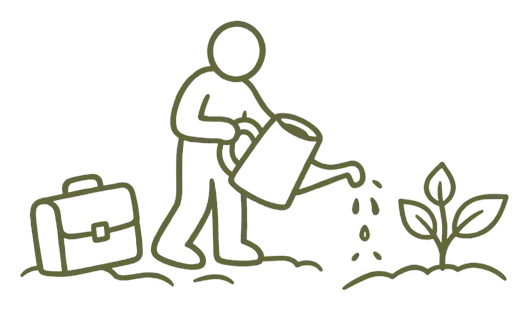
So one of the first steps to rediscovering yourself outside of work is realizing that you actually do exist… fully and completely… outside of your career.
Where have you felt a spark of yourself?
Here’s an idea that I’ve used for myself when trying to find moments that remind me of who I am.
I’ll make a private list of moments when I felt energized, connected, excited, or simply glad to be there in that moment. Think of them as little sparks: moments when something in you lit up.
I’ll go back as far as I can remember. I’ll look at relationships, hobbies, conversations, gifts, birthdays, and experiences at work… to name a few. The memories can be silly, deeply personal, or things you would never tell anyone else. And they don’t have to be really big exciting roaring fires. Just tiny little moments usually carry some of the strongest signals.
Use two columns:
- The moment: What happened?
- The why: What about it felt good? What gave you energy, connection, or a sense of being yourself?
Then in that second column, I want to really understand what about each of the moments gave me that little spark. If it was a person, what about the person? If it was a joke, what about the joke? If it was a TV show, what about the TV show? What gave me that tiny spark.
I like to think of this as a fun exercise, to remember the little sparks in my life. But for some, this reflection can bring some sadness, especially when you remember something you no longer have. If it becomes too painful or overwhelming, pause and consider exploring it with a therapist. You do not have to push through difficult memories on your own.
How can you bring one small spark back?
Look down the “why” column for patterns. Perhaps several memories involve making someone laugh, learning something, moving your body, or feeling close to other people. You might find several patterns, maybe some related or other completely out of left field.
Choose one of those patterns of spark and ask: What is one small thing I can do, to bring a tiny bit of this pattern back and reintroduce this spark in my life?
For example, if physical activity appears repeatedly, you might try a few minutes of movement that suits your body and circumstances this week.
Introduce a little spark and notice how it feels. Try another. Some things may still matter to you; others may have changed.
You did not lose touch with yourself overnight. Rediscovery takes time, too. A few small moments, repeated, can give you more room to experience who you are beyond work.
Over time, these little sparks are tiny reminders of who you really are outside of your career. We light up because they’re true and authentic to who we are and what is meaningful to us. No matter how small. No matter how silly.