
Do my interests have to fit together immediately?
When thinking about treating your career as a craft, we typically gravitate towards the competencies and dimensions of our job that fit really well together.
For example, bringing products to market in a large enterprise that sells to other large enterprises can involve considerable complexity. That kind of work may require coordination across many teams, so enjoying large-scale collaboration could fit well with that environment.
As you explore the dimensions of your profession, you will probably notice connections like this. Even walking your own career timeline, you’ve naturally gravitated towards jobs that have connections that seem to fit really well. And, sometimes those existing connections are what keep us trapped in jobs like those ones. They’re familiar, they go together well, AND everyone is also working in those same connections.
For your first pass at defining your craft, I would encourage you to keep the possibilities far more open.
Do not remove something you enjoy simply because you cannot yet see how it fits with the other things you want.
We can become so focused on what we think the rules are, or what a job should look like, that we leave very little room to explore what it could look like.
Let’s look at an example to make it a bit more concrete.
What if I enjoy two things that seem contradictory?
Suppose you enjoy enterprise organizations and the complexity of selling to other enterprise companies, but you also strongly prefer working independently.
At first, those preferences might seem incompatible. The environment appears to demand collaboration, while you want room to work on your own. Usually enterprise to enterprise B2B selling is a multi-person, multi-team effort, and at first glance working independently doesn’t seem to fit well.
Before deciding that one preference has to go, ask a different question:
What would the work need to look like for both of those things to be present?
There may be projects within a large organization that involve substantial independent work, even when the overall effort is collaborative. There may be a role with a different balance of individual ownership and coordination.
The possibilities might sit within your current profession, in an adjacent profession, or in a different arrangement altogether. And to some more extreme examples, contracting or consulting could be another avenue to investigate.
How could one preference make me better at the other?
There is another way to explore the same combination.
Instead of only asking where you could work independently, ask what you enjoy about independent work and how that might improve your contribution to a collaborative project.
Perhaps you like having time to think something through, form a perspective, and make progress before bringing other people into it. That could help you arrive at a group discussion with something useful for the team to examine.
Or perhaps your strength is taking ownership of a defined piece of work and carrying it forward without needing constant coordination.
Those are possible connections, not descriptions of everyone who prefers working alone. The point is to investigate your own reasons.
A team can need both collaboration and people who can make progress independently. Your preference for one may shape how you contribute to the other.
Sometimes the combination that initially looks contradictory helps you explain your approach to work more clearly.
Which interests should I bring into this exploration?
If you have completed the knowledge, skill, and enjoyment assessment, look at the capabilities and dimensions where enjoyment is high.
Some will also have high knowledge and skill. Others will be areas you enjoy where your knowledge and skill are still developing.
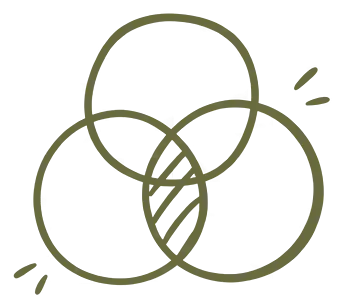
These are the pieces you can begin bringing together at the center of your craft.
For this first pass, give yourself room to include the combinations that seem wonky or outlandish. Their distance from each other can stretch your creativity and prompt questions you would not otherwise ask.
How could this capability work in that environment? How might this way of thinking change how I solve that problem? What does one interest help me notice about another?
You may discover an unusual direction to explore. You may also find a more specific way to describe the work you already do.
What if I cannot find the connection?
Finding these patterns is one of my favorite parts of coaching.
When I explore someone’s career alongside their interests and experiences outside work, I often find connections they have not recognized themselves. Sometimes the pattern has been present for years, showing up in different forms across their work and life.
If you are struggling to see how your interests connect, you can book a coaching appointment with me. Exploring those possibilities together is work I particularly enjoy.
You can also begin by writing down the pieces that seem incompatible and asking what each one means to you. What is it about working independently that you enjoy? What draws you to a large organization? The reasons underneath the preferences may give you more to work with than the labels alone.
You do not have to make every interest fit into one job. But you can give each possibility a fair exploration before ruling it out.
Your first version of your craft does not have to resemble a job description you have already seen. It can begin with a combination that interests you enough to ask, “What could this become?”